The Attention Argument: What the Belgian OOH Industry Is Really Talking About
Introduction
Date
Author
billups
Type
Articles
Thirty-eight people spent twenty minutes walking through central Brussels believing they were helping with a study on urban landscaping. They weren’t. The eye-tracking glasses they wore were recording, fixation by fixation, whether anyone actually looks at digital out-of-home advertising.
The answer — unveiled as a world premiere at billups’ fifth annual Unleash the Full Potential of OOH event at MIX Brussels — became the question the whole day was really about. The event brings the Belgian and wider European OOH community together each year to take stock of how the medium is evolving; this year, the room wasn’t talking about screens or formats. It was talking about attention: who actually has it, how to measure it honestly, and what it’s worth to a media plan.
That conversation opened with a welcome. Koen Van Rhijn, billups’ Managing Director Belgium and the event’s co-host, framed five editions of the gathering as a record of how far out-of-home has travelled — more creative, more digital, more measurable, more connected — without losing what makes it work.
The day, he said, was a chance to look at that evolution — and to look ahead.
The medium’s edge is trust — and its problem is share
James McEwan, billups’ CEO EMEA, then sharpened that framing into a challenge. In a digital environment where ad avoidance is routine, where identity and delivery are increasingly hard to verify, and where audiences are surrounded by unreliable information, he argued, the public’s trust in Out-of-Home has become a real competitive advantage — a medium that reaches people in the physical world, in the moments that actually matter to them.
The problem is that the trust hasn’t translated into spend. Global out-of-home ad spend is forecast at $56 billion in 2026, a fifth of it in EMEA — yet the medium’s share of total advertising has hovered around 5–6% for a decade. As McEwan put it, quoting billups’ global CEO David Krupp: growth without share is not the same as progress. Closing that gap, he argued, means leaning into trust, sharpening measurement, and staying credible in an AI economy that has already produced the world’s first fully automated, end-to-end out-of-home campaign. Almost everything that followed — the creativity, the attention data, the effectiveness case — was, in effect, an attempt to do exactly that.
Attention has to be earned before it can be measured
That conversation began long before the data did. The morning belonged to creativity — and to the argument that none of the afternoon’s numbers mean anything without work good enough to earn the look in the first place.
Katy Hopkins, an executive creative director recognised at Cannes Lions, D&AD and the One Show, opened the day by naming the problem the whole event circled: an attention crisis. The average person checks their phone 96 times a day, she noted, and there is more content being produced than anyone could watch in a thousand lifetimes. Most commercial work simply gets tolerated — approved because it offends no one, and forgotten minutes later. Out-of-home, in her telling, is the medium built to break that pattern, because it disrupts the real world, where there is no feed to scroll past and no filter to hide behind. The work that earns attention there does three things: it stays simple enough to land in half a second, stands out enough to stop someone, and at its best becomes a spectacle people seek out and share.
Dr. Lee Bofkin, co-founder of Global Street Art, put a commercial frame around the same idea: creativity isn’t a luxury but a return-on-investment lever — after the size of a brand itself, the biggest driver of return is how creative the advertising is. “You cannot bore your clients into buying your products,” he said. “You can only interest them.” His case for hand-painted murals was, pointedly, an argument from evidence: painted work scores measurably higher on emotional response, dwell time and recall than the same image on a screen — “the medium supports the message” — and what stops people in the street also travels, because “if something works URL, it also works IRL.”
Mathieu France, founder of Art Crush, pushed creativity one step further — from something brands show to something audiences help make. His case for user-, community- and artist-generated work was a Belgian one: a campaign built from schoolchildren’s drawings ran across 750 billboards and a hand-painted Brussels mural the children themselves helped paint, earned national press and television coverage, and lifted sales 23%. The lesson he left the room with was deceptively small — stop treating polished brand work and genuine participation as a choice: “Replace ‘or’ with ‘and.’”
Attention, measured where people actually encounter it
If the morning made the creative case, the afternoon brought the proof. Attention research has tended to happen in labs, or on Times Square — neither of which looks much like a two-square-metre screen on a Belgian street. The study presented by JCDecaux Belgium & Luxembourg and dentsu changed that: the first research to test street, shopping mall and metro environments in a single piece of real-life fieldwork, scaled through a 3,000-respondent survey.

“When I started in Out-of-Home, I had one question: we always talk about mass reach — 4.5 million contacts, 6.5 million — but how many of those people actually view the advertisement? Today, we can give you the answer.” — Branko Kleynen, dentsu
The numbers landed. 56% of participants made at least one spontaneous, active eye fixation on a single screen — unprompted, and unaware they were in an advertising study at all. Added together, each screen earned one to two seconds of genuine attention: on par with what online media achieves, and roughly 30% of a six-second spot. One in three participants recalled seeing the advertising entirely unprompted.
Context shapes the result. Streets deliver massive attentive reach; malls deliver quality contacts, with stronger product recognition and brand transfer; the metro is the stable all-rounder — with untested upside, given the average four-minute platform wait. The study’s most consequential output may be a new planning unit: attentive seconds, a way to plan and evaluate campaigns on actual eyes-on-poster rather than opportunity to see. As JCDecaux’s Veerle Colin put it: “Out-of-home is real. It has its impact in the real world, where there are lots and lots of stimuli — and we have to take that into account.”
The skip economy stops at the street
Alison Keith — founder of the Excellence Office and formerly lobal head of media at Coty and Kraft Heinz — gave the afternoon its sharpest frame: most marketing now operates inside a skip economy of its own making. 93% of consumers skip or ignore ads. System1 and Peter Field found 52% of UK TV ad responses emotionally blank. Advertisers, she argued, are paying two invisible taxes — a skip tax for impressions that evaporate, and a dull tax for the ones that land and do nothing.
Out-of-home escapes both, structurally.
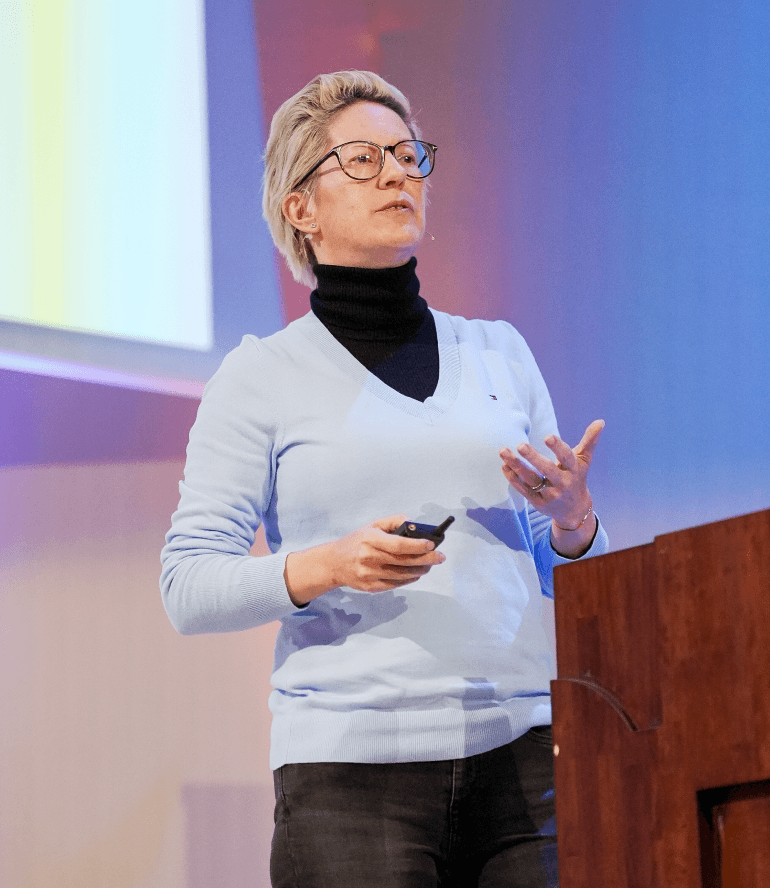
“Out-of-home was the only medium that never asked for permission to be there in the first place. You can make a bad out-of-home ad — but it’s very hard to make an invisible one.” — Alison Keith, Excellence Office
The attention research agrees: Karen Nelson-Field’s studies show 89% of OOH exposures hold attention beyond 2.5 seconds — a threshold most digital advertising fails — and out-of-home reaches 94% of Belgians every single week.
The creative case is now testable in minutes
That creative argument is no longer just an assertion from the stage — it has become something a planner can measure before a campaign runs. One finding ran through every session: roughly half a campaign’s success is the creative itself. The eye-tracking work added practical nuance. People in an ad attract attention, but can run away with it. Half a second is enough for a passer-by to register a logo and three words, so simplicity wins. And while static and animated creative perform similarly, full motion lifts reach significantly — provided the motion is well designed. Poorly designed animation underperformed everything.
What has changed is the feedback loop. Oliver Ford, Business Director International at billups, showcased our AI agentic system audrai's creative diagnostics that once cost €6,000 and took two weeks now happening in minutes — citing one campaign where simply repositioning and enlarging the logo took brand visibility from 2% of viewers to 40%.
The argument problem just became winnable
The day’s most uncomfortable statistic was the share-of-spend gap McEwan opened with, now set plainly against digital. Digital takes 67 cents of every advertising euro spent in Europe; out-of-home — the medium that escapes the skip economy entirely — sits at 6–7% globally, and 12% in Belgium.
The gap is an argument problem. It just hasn’t been argued loudly enough — out-of-home gets deprioritised by people who are optimising towards measurability rather than effectiveness. And those are two fundamentally different things.
— Alison Keith, Excellence Office
What made this afternoon in Brussels feel different is that the missing pieces showed up together, in one room. The proof: attention, measured in the wild. The argument: a medium people trust rather than tolerate. And the tools: as Keith noted, billups’ quantifiable attention metrics are making the argument easier to make — while Ford demonstrated audrai, billups’ OOH-native AI, turning a ten-market brief that would once have taken two weeks into a four-hour response, and surfacing high-indexing sites no planner would have thought to fight over.
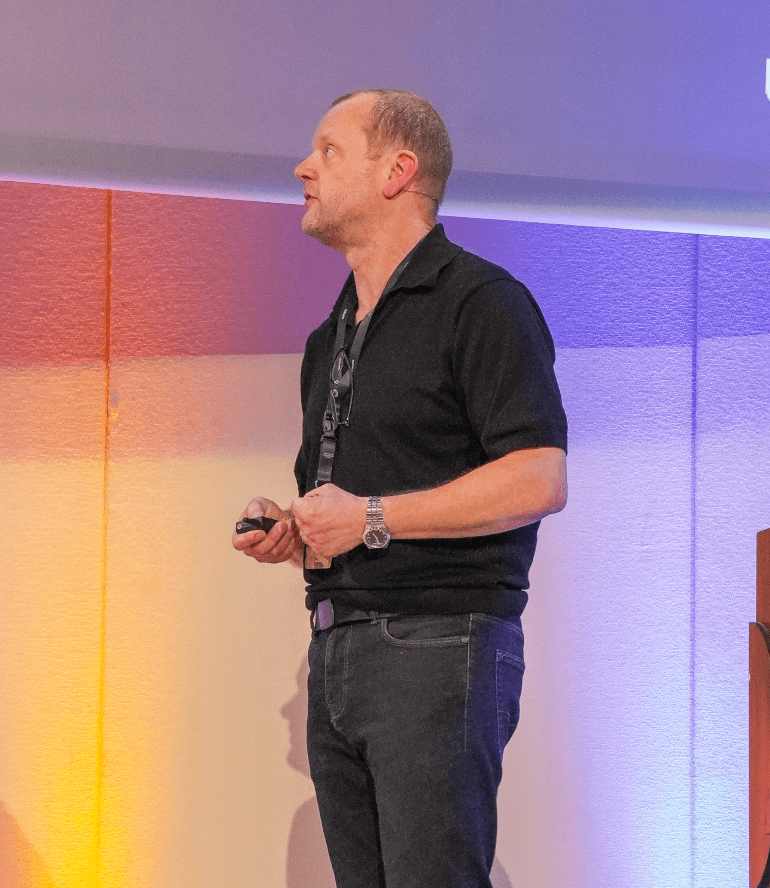
“AI won’t replace marketers, but marketers who use AI will replace those who don’t.”— Oliver Ford, billups
From belief to evidence
McEwan closed the day with the recipe: bold creativity that deserves attention, the right measurement taxonomy, technology that simplifies activation at scale, and an industry willing to make the case together.
For years, out-of-home has asked the market to believe in attention it couldn’t fully evidence. In Brussels, the industry stopped asking for belief and started proving it. Or, in the phrase that echoed through the room all afternoon: it has to be out-of-home.
Our news